Technical SEO is not optional
Content and backlinks receive the majority of attention in SEO discussions, for understandable reasons: they are more immediately tangible than the technical infrastructure that sits beneath them. But a website with exceptional content and strong backlink authority will consistently underperform against its potential if its technical foundation is weak. Crawlability, page speed, mobile performance, structured data, and site architecture all influence organic search rankings directly. They also influence conversion rate, independently of their SEO impact.
The compounding effect is significant. A technically sound website with good content and reasonable backlinks can outrank a technically weak website with great content and excellent backlinks, mostly where competing pages are otherwise close, since Google treats page experience as one signal among many.
Core Web Vitals: the metrics that now move rankings
Google’s Core Web Vitals (Largest Contentful Paint, Interaction to Next Paint, and Cumulative Layout Shift) are a confirmed ranking signal. LCP measures how quickly the main content of a page loads; an LCP under 2.5 seconds is considered good, above 4 seconds is poor (web.dev) and will negatively affect rankings. INP measures how responsively a page reacts to user interactions; CLS measures visual stability during page load: the jarring experience of content shifting as elements load asynchronously.
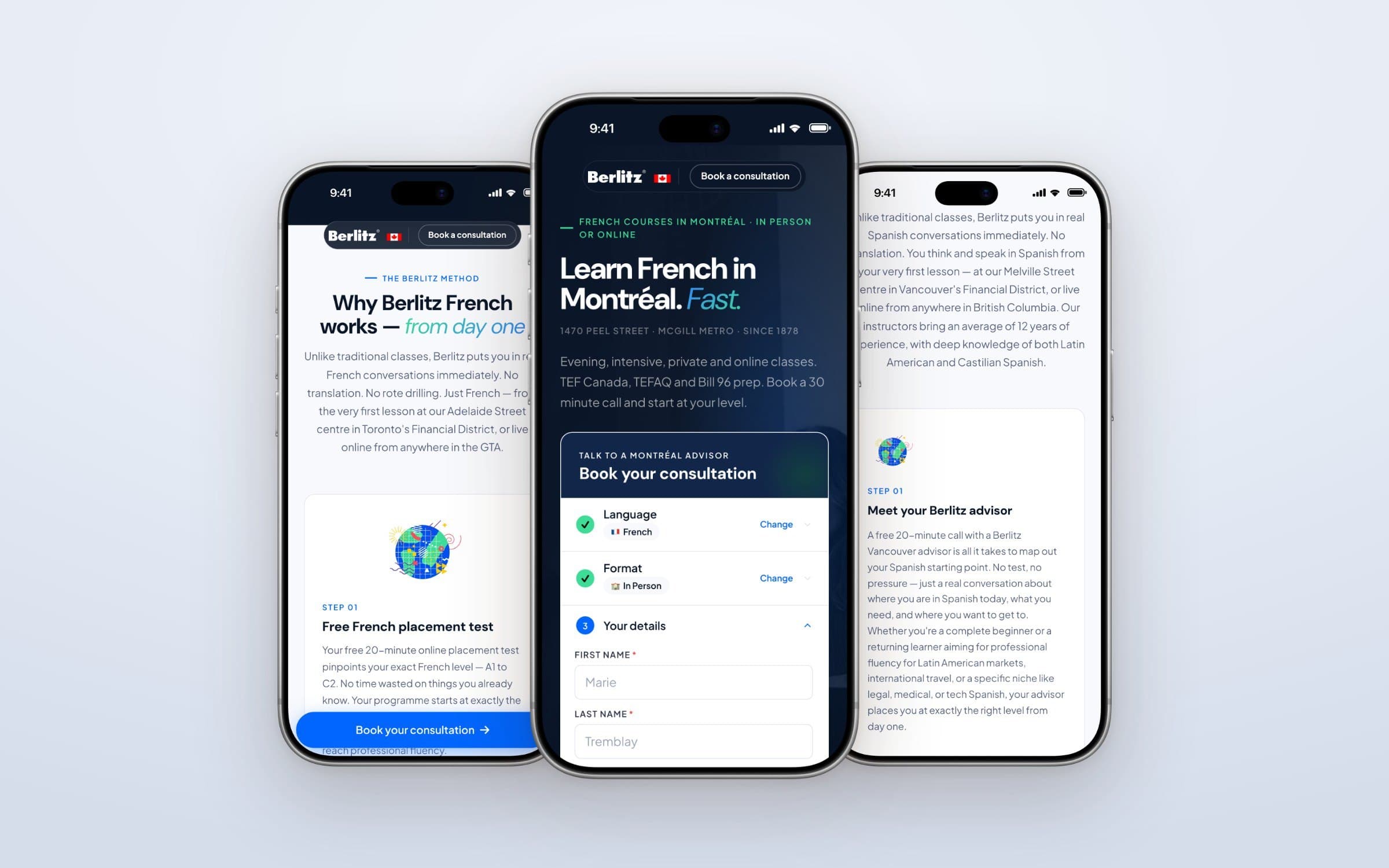
Magic Pulpo’s standard for client website deliverables is an LCP under 2 seconds on mobile, an INP under 150 milliseconds, and a CLS score below 0.1. The Berlitz Digital School website, built in Webflow, scored 94 out of 100 for performance in Lighthouse on initial delivery (a lab test, which covers load speed and layout shift but not INP). The practical consequence of hitting these scores consistently is a measurable advantage in mobile search ranking over competitors who have not optimised for Core Web Vitals.
The standard we build to
Mobile performance: the real frontier
Desktop performance optimisation is relatively straightforward and well-understood by most development teams. Mobile performance is where most websites have the largest gap between current state and best practice, and where the SEO impact is greatest, because Google now uses mobile-first indexing for all websites. The version of your website that Google evaluates for ranking purposes is the mobile version.
Common mobile performance problems include images that are not resized for mobile viewports (a single large desktop image loaded on a mobile connection dramatically increases LCP), JavaScript bundles that block rendering on slower mobile processors, and third-party scripts (analytics, advertising, chat widgets) that load synchronously rather than being deferred. Each of these is fixable with well-established techniques; the problem is that they require active audit and remediation rather than emerging naturally from standard development practices.
Where mobile performance actually goes
Structured data and AI-readiness
Structured data (JSON-LD markup that describes the content and context of a page to search engines and AI systems) is the least glamorous and most underinvested technical SEO factor on most websites. It does not improve page speed or visual design. But it does directly influence how search engines understand and present your content, and it is increasingly relevant to how AI-powered search systems surface and cite information.
FAQ schema, for example, used to earn rich results in Google Search, but since August 2023 Google shows them only for well-known government and health sites. It still tells search engines and AI systems which questions a page answers. Article schema improves the quality of how news and blog content is indexed and attributed. Organization schema helps establish your brand as a clearly defined entity in Google’s Knowledge Graph, which matters both for search and for how AI systems respond to queries about your brand or sector.
If you would like a technical SEO audit of your current website, get in touch with the Magic Pulpo technology team.