
Why campaign structure determines performance
Google Ads performance is determined more by campaign structure than by budget. An account with a well-designed campaign architecture, tight ad group theming, and precise match type strategy will consistently outperform an account with double the budget but poor structural foundations. The reason is Quality Score: Google's internal rating of how relevant your ads, keywords, and landing pages are to each other and to the user's search query. Better ad quality tends to bring a lower cost per click and better positions, and the landing page is a third of what Google measures.
Account hierarchy: campaigns, ad groups, and keywords
The Google Ads account hierarchy has three levels. Campaigns control budget and bidding strategy at the highest level. Each campaign is a separate budget bucket with its own daily spend limit and bidding approach. Ad groups within each campaign control the thematic grouping of keywords and their associated ads. Keywords within each ad group determine which search queries trigger your ads.
The hierarchy, and what each level controls
The most common structural error in Google Ads is creating ad groups that are too broad: grouping together keywords that represent different user intents, different stages of the purchase funnel, or different product categories. A single ad group containing "digital marketing agency," "social media agency," and "content marketing agency" cannot produce a highly relevant ad for all three queries simultaneously, because the specific intent behind each is different.
Match types now
Google's match type options have simplified significantly in recent years. Broad match now incorporates machine learning to match queries based on intent rather than just keyword overlap. That makes it significantly more capable than its predecessor but also more unpredictable without smart bidding. Phrase match targets queries containing your keyword's meaning in sequence. Exact match targets queries with the same meaning as your keyword with minimal additional context.
The right match type strategy today depends on account maturity and data volume. New accounts with limited historical conversion data typically perform better with more restrictive match types (phrase and exact), which allow the campaign to accumulate clean signal data before introducing the broader query matching of smart bidding campaigns. Mature accounts with sufficient conversion data typically perform better with smart bidding plus broader match types, allowing the algorithm to find intent signals that exact match would miss.
A well-built account on a modest budget routinely outperforms a badly built one spending several times more. The architecture is the lever, not the spend.
Quality Score: the multiplier that most advertisers undervalue
Quality Score is Google's assessment of the relevance and expected performance of your ads, expressed as a 1-10 score at keyword level. Google calls it a diagnostic tool and says it is not itself an input in the ad auction (Google Ads Help). The ad quality it measures does count, though: Google says higher quality ads can often lead to lower costs per click (Google Ads Help). That means two advertisers bidding the same amount can have very different costs per click and therefore different effective returns on their advertising spend.
Quality Score is driven by three factors: expected click-through rate (how often people click your ad when it appears), ad relevance (how closely your ad matches the intent behind the search query), and landing page experience (how relevant, transparent, and fast your landing page is for someone arriving from that search). The last factor is consistently the most underinvested: most advertisers focus on ad optimisation while sending traffic to generic pages that do not address the specific query intent that generated the click.
The three inputs to Quality Score
It optimises for whatever you call a conversion. Point it at a micro-conversion and it will get you a great deal of that instead of revenue.
Bidding strategy selection
Google offers two categories of bidding strategy: manual bidding (where you set bids directly) and automated bidding (where Google's algorithm sets bids based on predicted conversion probability). Manual bidding gives maximum control but requires constant management and does not incorporate the real-time signals that automated bidding uses. Automated bidding strategies (Target CPA, Target ROAS, and Maximize Conversions) use machine learning to set bids based on signals including device, location, time of day, audience membership, and previous site behaviour.
Target CPA (target cost per acquisition) is the standard recommendation for lead generation accounts with consistent conversion values. Target ROAS (target return on ad spend) is recommended for e-commerce accounts where conversion values vary. Target ROAS on Search and Shopping needs at least 15 conversions in the past 30 days (Google Ads Help), and Google recommends evaluating Target CPA over at least 30 conversions in 30 days (Google Ads Help). Below these levels, the algorithm has insufficient data to optimise reliably.
The critical requirement is accurate conversion data. Smart Bidding optimises for whatever you define as a conversion. If your conversion tracking is measuring micro-conversions (page views, time on site) rather than actual business outcomes (qualified leads, purchases), the algorithm will optimise for the wrong objective with increasing efficiency. Conversion data quality is more important than bidding strategy selection.
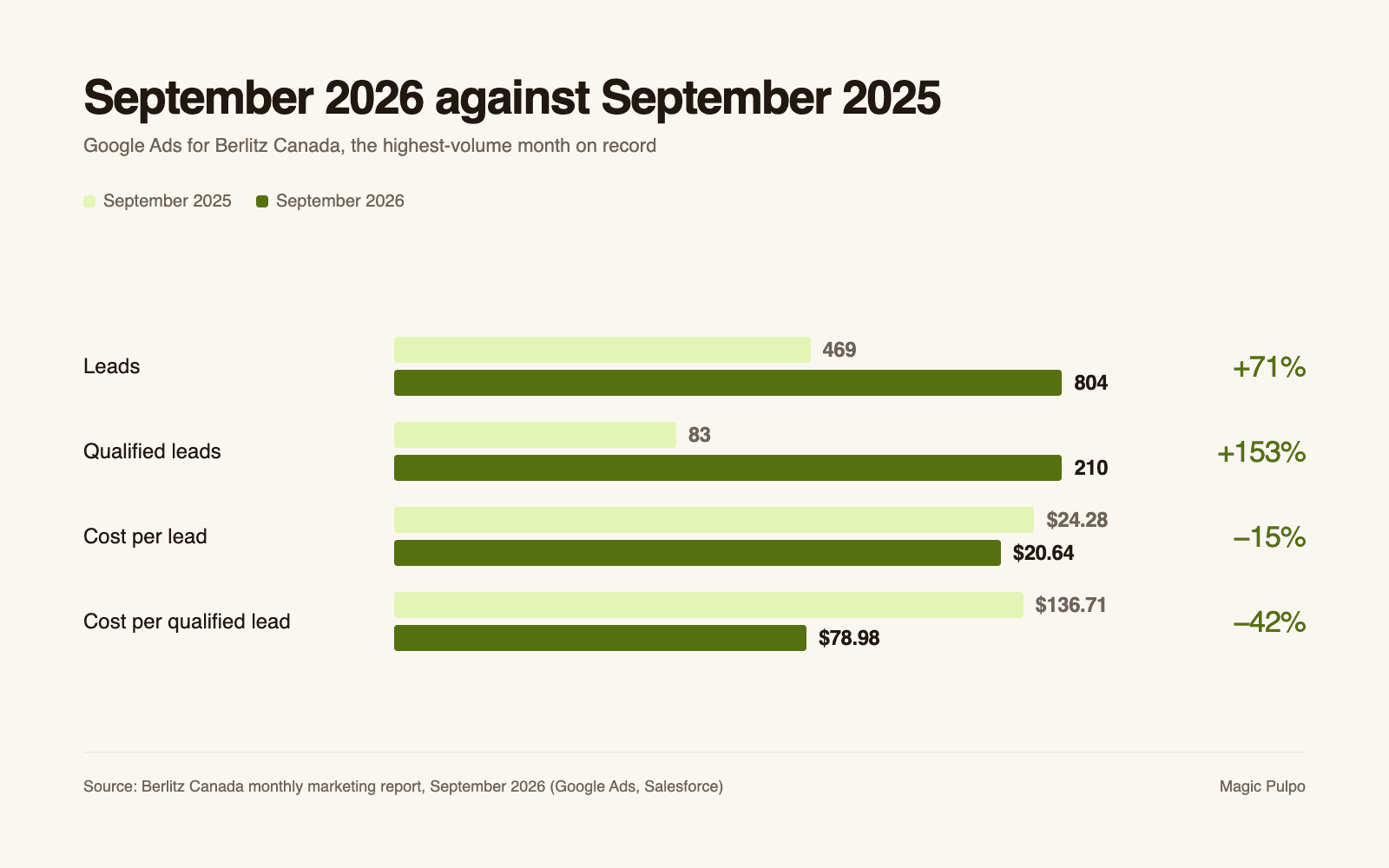
Magic Pulpo manages Google Ads campaigns for Berlitz across Canada, UK, and global markets using a combination of smart bidding strategies calibrated to each market's conversion volume and seasonal patterns.
Cross-channel attribution: connecting PPC to business outcomes
Last-click attribution, the default in most PPC reporting, systematically undervalues top-of-funnel paid search by giving 100% conversion credit to whichever touchpoint immediately preceded the conversion. For considered purchases with multi-week sales cycles, this means branded search and retargeting campaigns appear to drive all performance, while the non-branded queries that initiated the customer relationship receive zero credit.
What last-click tells you about a multi-week sale
Branded search and retargeting appear to drive everything. They got 100% of the credit for being last in line.
The non-branded query that started the relationship gets credit for starting it, so you stop cutting the thing that feeds the funnel.
Google Ads' data-driven attribution model distributes credit based on observed contribution patterns in your account's conversion data. Implementing GA4 with proper cross-platform data integration enables comparison of attribution models across your full channel mix, and typically reveals that paid search's contribution to business outcomes is both larger and more varied than last-click reporting indicates.
If you want a PPC audit or are looking to launch or restructure a paid search programme, speak to the Magic Pulpo performance marketing team.

Magic Pulpo
Agencia de crecimiento × startup studio, Budapest