
Why most landing pages underperform
Unbounce's 2024 benchmark of 41,000 landing pages puts the average conversion rate at around 6.6% across industries, and Unbounce counts 10% or more as good (Unbounce). The gap between an average page and a good one represents recoverable revenue: the same paid media spend, the same organic traffic, dramatically different outcomes based on what happens after the click.
Average against good
The causes of underperformance are almost always diagnostic rather than creative. The headline doesn't match the ad that sent the visitor. The form asks for too much information too early. The page loads slowly on mobile. The CTA is buried below the fold. The value proposition is vague. These are structural problems that can be identified through systematic analysis, not creative intuition.
The diagnostic framework: four questions
Before testing anything, answer four diagnostic questions about your current page. First: does the page message match the ad or search intent that drove the visitor? Message mismatch (where the page headline contradicts or ignores the promise of the upstream ad) is the single most common cause of poor landing page performance. Second: is the value proposition clear in the first five seconds? If a new visitor cannot articulate what you offer and why they should care within five seconds of landing, the conversion is already lost for most. Third: does the page remove friction before asking for commitment? Every form field and every extra step adds to abandonment, and so does any moment of uncertainty. Fourth: is there enough proof next to the ask? A claim with nothing beside the form asks the visitor to take you on trust; a number, a logo or a named result makes saying yes reasonable. Mobile and speed sit underneath all four. Mobile traffic is often more than half of landing page visits; a mobile experience that requires pinch-zooming or has tap targets that miss half the time will cut your effective conversion rate sharply.
As the technical SEO guide covers, page speed affects conversion directly and independently of its SEO impact. The BBC found it lost an additional 10% of users for every extra second its site took to load (web.dev).
What a second costs
Four questions before you test anything
The research stack
A CRO research programme draws on four categories of data. Quantitative analytics: where users are dropping off, which pages have high exit rates, which user segments have the lowest conversion rates. This data tells you where the problems are but not why they exist.
The four inputs before any test is designed
Qualitative research: user recordings (tools like Hotjar or Microsoft Clarity), on-page surveys, and usability testing. This data tells you why users behave the way the analytics show they do: the specific friction points, confusions, and objections that prevent conversion.
Competitive analysis: how competitors are solving the same conversion problems. The aim is to understand the category conventions that users arrive with and the gaps that present competitive differentiation opportunities.
Customer data: conversations with existing customers about what nearly prevented them from converting, what finally made them decide to proceed, and what questions they had that the website failed to answer. This is the most underused source of CRO insight in most organisations.
The hypothesis framework
A well-formed CRO hypothesis has three components: an observation (what the research shows is happening), a proposed change (what you intend to do about it), and a predicted outcome (what you expect to happen as a result). "We observed that 65% of users who reach the pricing page leave without converting, and qualitative research shows that the most common exit point is immediately after viewing prices. We propose adding a price comparison table showing the ROI of our service vs the status quo. We predict this will reduce pricing page exit rate by 20% and increase trial sign-up rate from the pricing page by 15%."
This format forces specificity, connects the change to the evidence, and creates a clear criterion for whether the test succeeded. It also makes prioritisation easier: hypotheses backed by strong evidence and predicting large impact are tested before hypotheses backed by instinct and predicting marginal change.
Testing methodology: what actually works
A/B testing is the gold standard for landing page optimisation, but most organisations run tests incorrectly and draw conclusions from statistically insignificant results. Before launching a test, calculate the required sample size for statistical significance at 95% confidence. For a page converting at 3% with a minimum detectable effect of 20% (relative), you need roughly 14,000 visitors per variant at 80% statistical power. If your page doesn't receive that volume, you cannot run meaningful A/B tests.
For lower-traffic pages, qualitative research methods (session recordings, heatmaps, user interviews) provide insight without requiring statistical significance. These tools identify friction points and confusion that quantitative data cannot explain.
The highest-impact test types by page section
Headline tests consistently produce the largest impact on conversion rate and should be the first priority for any optimisation programme. Value proposition clarity, specificity, and relevance to visitor intent all affect headline performance. Button copy tests ("Get Started" vs "Book Your Free Consultation" vs "See Pricing") often produce clear conversion rate differences. And form length tests, where reducing the number of required fields is typically the intervention, can lift conversion rate substantially on lead capture pages.
Social proof positioning (where testimonials, client logos, and case study references appear on the page relative to the conversion action) affects the persuasiveness of the conversion moment. Social proof placed immediately before or adjacent to the primary call-to-action consistently outperforms social proof placed further up the page or on a separate testimonials page.
The design of the call to action (button copy, colour, size, and surrounding white space) affects whether visitors who have decided to take action actually complete that action. Button copy that is specific about the outcome ("Get your free PPC audit" rather than "Submit") consistently outperforms generic action language.
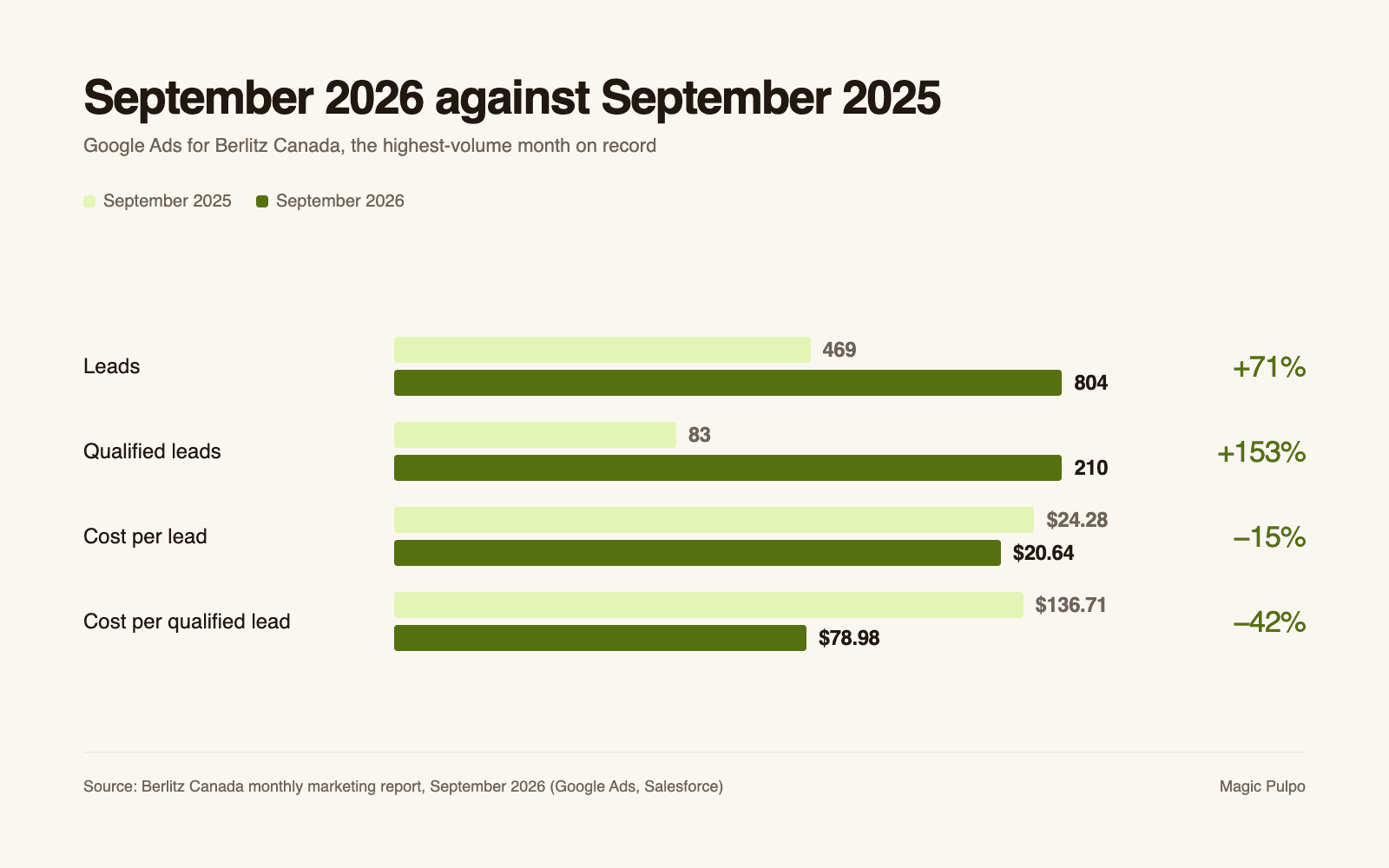
Magic Pulpo has designed and optimised landing pages for Berlitz in Canada, the UK and on the global site. On Berlitz UK's Speak by September offer campaign, 21% of the leads the page produced became paid enrolments. To discuss landing page strategy for your programmes, speak to our team.

Magic Pulpo
Agencia de crecimiento × startup studio, Budapest