Why most agency structures produce average work
The conventional agency model was built around specialisation by department: the creative team does creative, the media team does media, the digital team does digital. The problem is that brand challenges do not respect departmental boundaries. A paid acquisition campaign that ignores brand positioning will convert badly. A content strategy that ignores SEO will reach nobody. A product launch that does not coordinate across paid, organic, social, and UX simultaneously will underperform against one that does.
Octo-Thinking is Magic Pulpo’s answer to this structural problem. It is named after the octopus on our logo.
The octopus as a strategic model
An octopus has a distributed nervous system. Its arms and body hold over two-thirds of the animal’s neurons (ScienceDaily), and each arm can operate semi-independently, solving local problems without constant instruction from the central brain. But the central brain still coordinates, prioritises, and makes decisions that the arms cannot. The result is a system that is simultaneously decentralised and coherent.
Why the mascot is the model
This is exactly how Magic Pulpo operates, and it is the foundation of the Octo-Thinking framework. The disciplines we sell (research and insight, product design, web and application development, CRM and marketing automation, performance marketing, creative and content production and brand identity systems, with AI OS, AI automations, search and AI discoverability, AI governance and AI design systems on top) each operate with real autonomy in their own field, coordinated by a central strategic function that keeps every arm moving towards the same objective.
The disciplines and how they interconnect
In a conventional agency, twelve disciplines mean twelve separate briefs and twelve separate teams, whose output may or may not align when it arrives on the client’s desk. In the Octo-Thinking model, the disciplines share a single strategic brief and are deployed in the sequence and combination that the specific challenge requires.
For a brand launch, this might mean brand architecture and visual identity running in parallel with technical website development, so that the design system is production-ready the moment the site goes live instead of six weeks later. For a performance marketing programme, it means content strategy and paid acquisition briefed simultaneously, so that the landing pages are written for conversion before the campaigns are built.
Octo-Thinking in practice: Berlitz
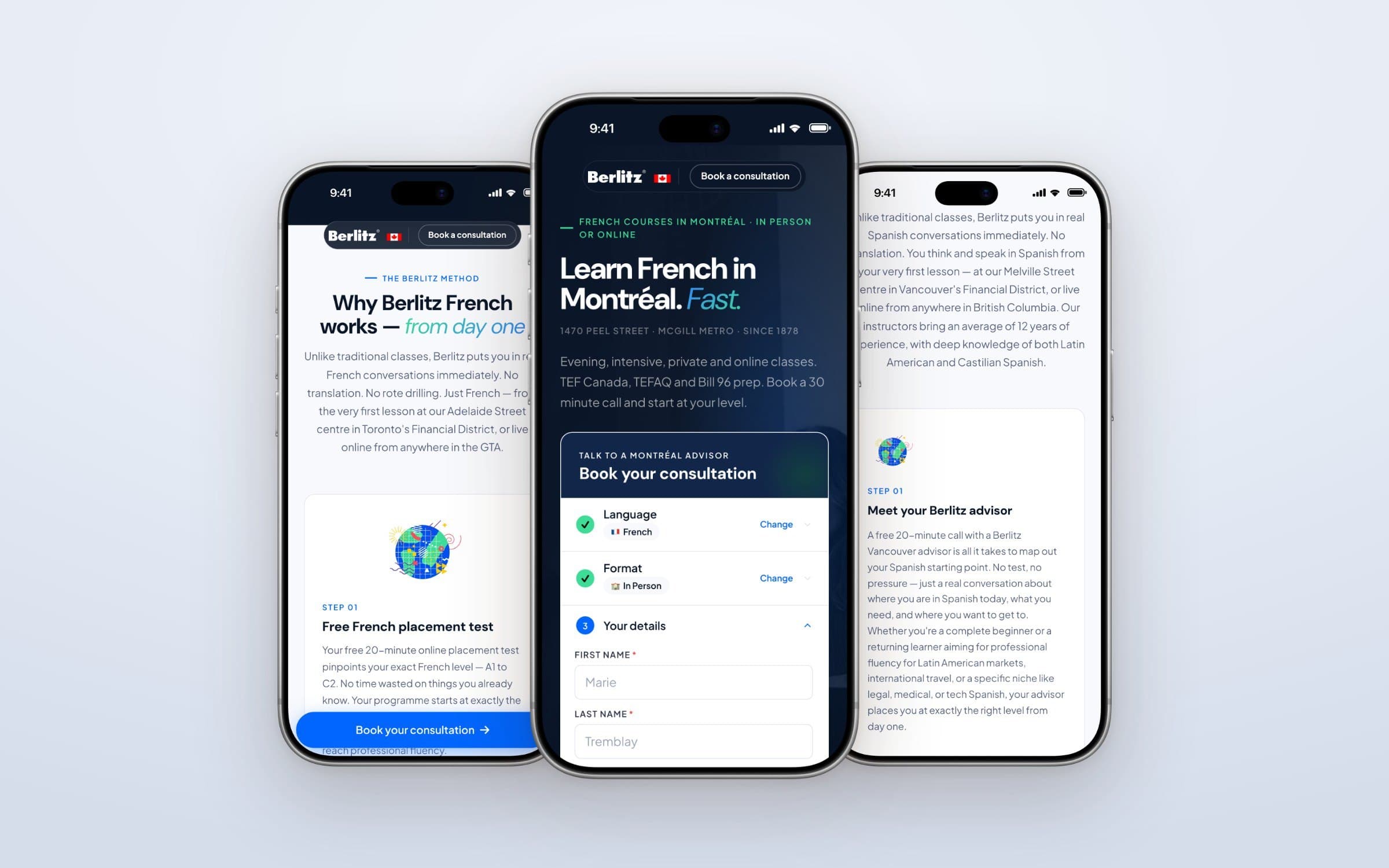
Our work for Berlitz is the clearest illustration of Octo-Thinking at work. Across Berlitz’s franchise markets, Canada and the UK among them, Magic Pulpo coordinates performance marketing, landing page development, SEO, social media management, email marketing automation, and brand content production simultaneously, with a single strategic layer ensuring that every channel reinforces rather than contradicts the others.
The results reflect this integration. The Berlitz Digital School website scored 94 out of 100 for performance in Lighthouse because development and design were briefed together. The paid campaigns convert because the landing pages are written and optimised by the same team running the ads. In Canada, the social programme grew because content strategy and community management shared a single editorial brief.
Why Octo-Thinking is particularly relevant now
A brand that excels at paid acquisition but ignores organic search is perpetually dependent on paid budget to sustain traffic. A brand with exceptional content but poor technical SEO is invisible to the audiences most likely to convert. Strong creative on weak data infrastructure cannot be optimised or scaled.
What single-discipline strength buys you
Octo-Thinking’s answer is structural: whichever disciplines you deploy are coordinated around shared objectives, shared data, and shared creative frameworks.
If you are evaluating whether your current agency structure is limiting your brand’s growth potential, speak to the Magic Pulpo team about how the Octo-Thinking model applies to your specific situation.